


Spread Betting in Cricket: Variable Profit, Variable Risk
The first time I tried cricket spread betting, I bought total runs at 285 on a Test match at The Oval. The match produced 612 runs across four innings. My profit scaled with every run above 285, and the final payout was substantial. The following week, I bought runs on a match that produced 195, and the loss per run below my buy price was equally dramatic. That two-week experience taught me everything about spread betting’s core proposition: the further the outcome moves from the spread, the more you win or lose.
The UK cricket betting market sits at roughly £52 million annually, a 2.2% share of the £2.37 billion online sports betting sector. Within that market, spread betting occupies a niche position — smaller in volume than fixed-odds but fiercely loyal in its following. Spread bettors tend to be experienced punters who want their cricket knowledge to translate directly into profit proportional to the accuracy of their prediction.
Unlike fixed-odds betting where your risk is limited to your stake, spread betting carries open-ended risk. That distinction is fundamental, and it’s the reason spread betting is regulated separately in the UK under the Financial Conduct Authority as well as being subject to Gambling Commission oversight.
How Cricket Spread Betting Works
A spread bettor doesn’t pick a winner — they trade on a numerical outcome. The spread firm quotes a range, say 280-290 for total match runs. If you think runs will exceed 290, you “buy” at 290. If you think runs will fall below 280, you “sell” at 280. Your profit or loss is calculated by multiplying your stake per point by the difference between the actual outcome and your entry price.
Suppose you buy total runs at 290 for £10 per run. The match produces 340 runs. You profit £500 — that’s 50 runs above your buy price multiplied by £10. If the match produces 250 runs, you lose £400 — 40 runs below your buy price multiplied by £10. The spread — the gap between the buy and sell prices — represents the firm’s margin, equivalent to the overround in fixed-odds betting.
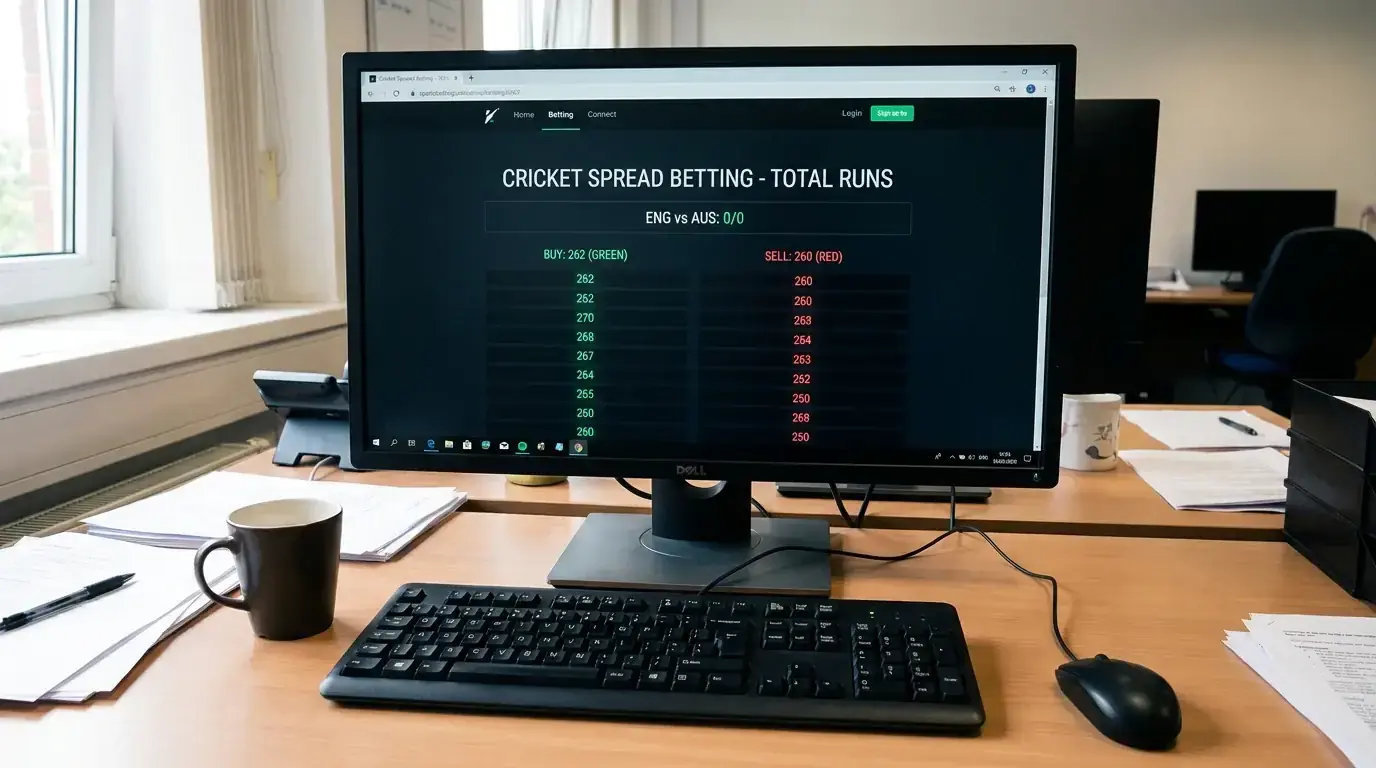
What makes this format compelling is that the size of your win or loss directly reflects how right or wrong you were. In fixed-odds betting, it doesn’t matter whether your team wins by one run or a hundred — the payout is the same. Spread betting rewards precision and punishes misjudgement proportionally, which appeals to bettors who trust their analytical models.
Common Cricket Spread Markets
Total match runs is the flagship cricket spread market, but it’s far from the only option. Spread firms offer markets on individual innings runs, total wickets, total boundaries (fours and sixes combined), a named batsman’s runs, a named bowler’s wickets, and even exotic markets like supremacy — the margin of victory measured in runs.
Batsman runs spreads are where I’ve found the most value over the years. A firm might quote Joe Root’s innings runs at 32-36. If I’ve analysed the conditions and bowling attack and believe Root is likely to score 50+, buying at 36 gives me exposure to the upside with a clear analytical basis. The key is being specific about why you expect an outcome above or below the spread, rather than trading on instinct.

Supremacy markets add another dimension. Instead of predicting total runs, you’re predicting the difference between two teams’ scores. A total runs market asks about volume; supremacy asks about dominance. The two markets often tell different stories about the same match, and experienced spread bettors will sometimes take positions on both.
Losses Can Exceed Your Stake: Managing Spread Risk
I cannot stress this enough: spread betting is fundamentally different from fixed-odds in terms of risk profile. When you place a fixed-odds bet, the maximum you can lose is your stake. When you buy or sell on a spread, your loss scales with how far the outcome moves against you. In theory, if you buy runs on a match that is washed out and scores zero, your loss could be your buy price multiplied by your stake per point.
Stop-loss mechanisms are available with most UK spread firms. A stop loss caps your maximum loss at a predetermined level. I use stop losses on every spread bet I place, without exception. The cost is a slightly wider spread — firms charge a premium for the protection — but the alternative is uncontrolled downside that can wipe out weeks of profitable trading in a single match.

Position sizing is equally critical. I never stake more than 1% of my total betting bankroll per point on any cricket spread. That means if my bankroll is £5,000, my maximum stake is £50 per point. Even a 30-point adverse move costs me £1,500, which is recoverable. At £200 per point, the same move costs £6,000, which isn’t. Discipline with position sizing is the difference between sustainable spread betting and a very expensive lesson.
Spread Betting vs Fixed-Odds: a Direct Comparison
The UK generates £16.8 billion in gross gaming yield annually across its entire gambling market. Fixed-odds dominates that figure, with spread betting representing a specialist segment. The practical differences between the two formats shape which type of bettor is best served by each.
Fixed-odds suits bettors who want defined risk, quick settlement, and the simplicity of picking a winner. You know exactly what you stand to win or lose before you place the bet. Spread betting suits bettors who want their return to scale with the accuracy of their prediction, who are comfortable with variable risk, and who treat betting as closer to financial trading than entertainment.

Tax treatment differs as well. Spread betting profits are currently tax-free for UK punters because spread betting is classified as gambling under UK tax law, despite being regulated by the FCA. Fixed-odds betting profits are also tax-free for punters — the Remote Gaming Duty is paid by the operator, not the customer. So while the regulatory frameworks differ, the tax outcome for the individual bettor is the same.

One area where spread betting has a structural advantage is in-play trading. Because your position is continuously marked to market as the match progresses, you can close out a spread bet mid-match to lock in profit or limit a loss. This is the equivalent of cash-out in fixed-odds betting, but with more granular control because you set your own exit price rather than accepting the bookmaker’s cash-out offer.
