

Why More Than Half of UK Cricket Bets Are Placed In-Play
The moment that hooked me on in-play cricket betting wasn’t a bet I won — it was a bet I placed at exactly the right time and watched the logic unfold in real time. It was an IPL match, the chasing side had lost three wickets in the powerplay, and the match winner odds had swung from 1.70 to 3.20. I backed the bowling side, and over the next ten overs, every ball confirmed the read. That feeling — of pattern meeting price at the precise moment of maximum dislocation — is what makes live cricket betting unlike anything else in the sport.
The numbers back this up. Roughly 55-60% of all cricket wagers placed by UK bettors are made in-play, not before the match starts. That proportion is higher than in football and significantly higher than in horse racing, and the reason is structural: cricket produces a continuous stream of discrete events — every ball is a fresh data point — that create constant opportunities for reassessment. Across the UK, around 290 million online bets on real events are placed every month, and cricket’s share of that in-play volume has grown steadily as bookmakers have expanded their live market offerings.
This guide breaks down how in-play cricket betting actually works, which markets are available mid-match, how dynamics differ across formats, and — most importantly — how to time your entries and exits in a market that moves faster than almost any other sport. I’ve spent thousands of hours betting live on cricket, and the strategies here are distilled from that experience, not from theory.
How In-Play Cricket Betting Works
The first time I tried to place an in-play cricket bet, the odds changed between me clicking the price and confirming the bet. The system rejected it and asked me to accept the new price. I fumbled, re-accepted, and by the time the bet went through, the moment had passed. That taught me something important: in-play betting is a different speed of decision-making, and understanding the mechanics before you’re in the moment is essential.
In-play betting opens the instant a match begins and stays available throughout, though specific markets may be suspended temporarily — typically during key events like a wicket falling, a review, or a strategic timeout. During these suspensions, no bets can be placed, and the odds are recalculated based on the new match state. Suspensions in cricket last anywhere from a few seconds (ball-by-ball recalculation) to a couple of minutes (pending a DRS review).
Bookmakers price in-play markets using a combination of algorithmic models and human trading oversight. The algorithms process live data feeds — runs scored, wickets taken, balls remaining, run rate, required rate — and adjust odds continuously. Human traders step in for situations the algorithm handles poorly: unusual match conditions, strategic declarations in Tests, or moments where the data doesn’t capture the full picture (like a pitch visibly deteriorating).
Most operators offer two options for handling price changes during bet placement. “Accept any odds” places your bet at whatever the current price is, even if it’s moved against you since you clicked. “Accept only better odds” rejects the bet if the price has shortened. I always use the second option. It means more rejected bets and slower execution, but it ensures I never take a worse price than I intended. In a fast-moving market, that discipline matters.
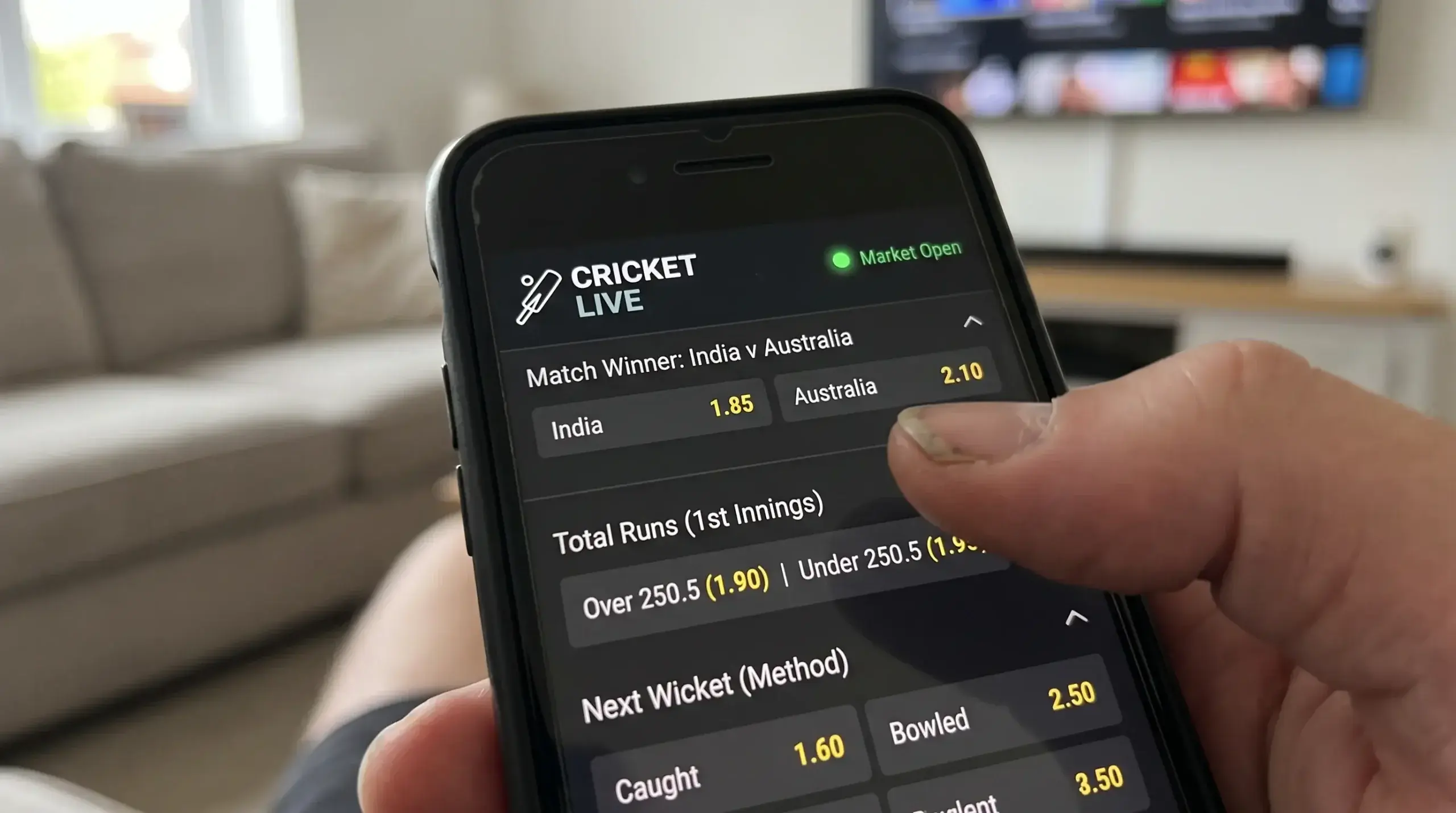
The bet types available in-play mirror pre-match markets in many cases — match winner, top batsman, total runs — but with odds that update continuously. Some markets are exclusive to in-play, like “runs in the next over,” “method of next dismissal,” or “batsman to hit next boundary.” These micro-markets are where in-play cricket betting gets most interesting, and most dangerous, because the pace of decision-making compresses into the gap between deliveries.
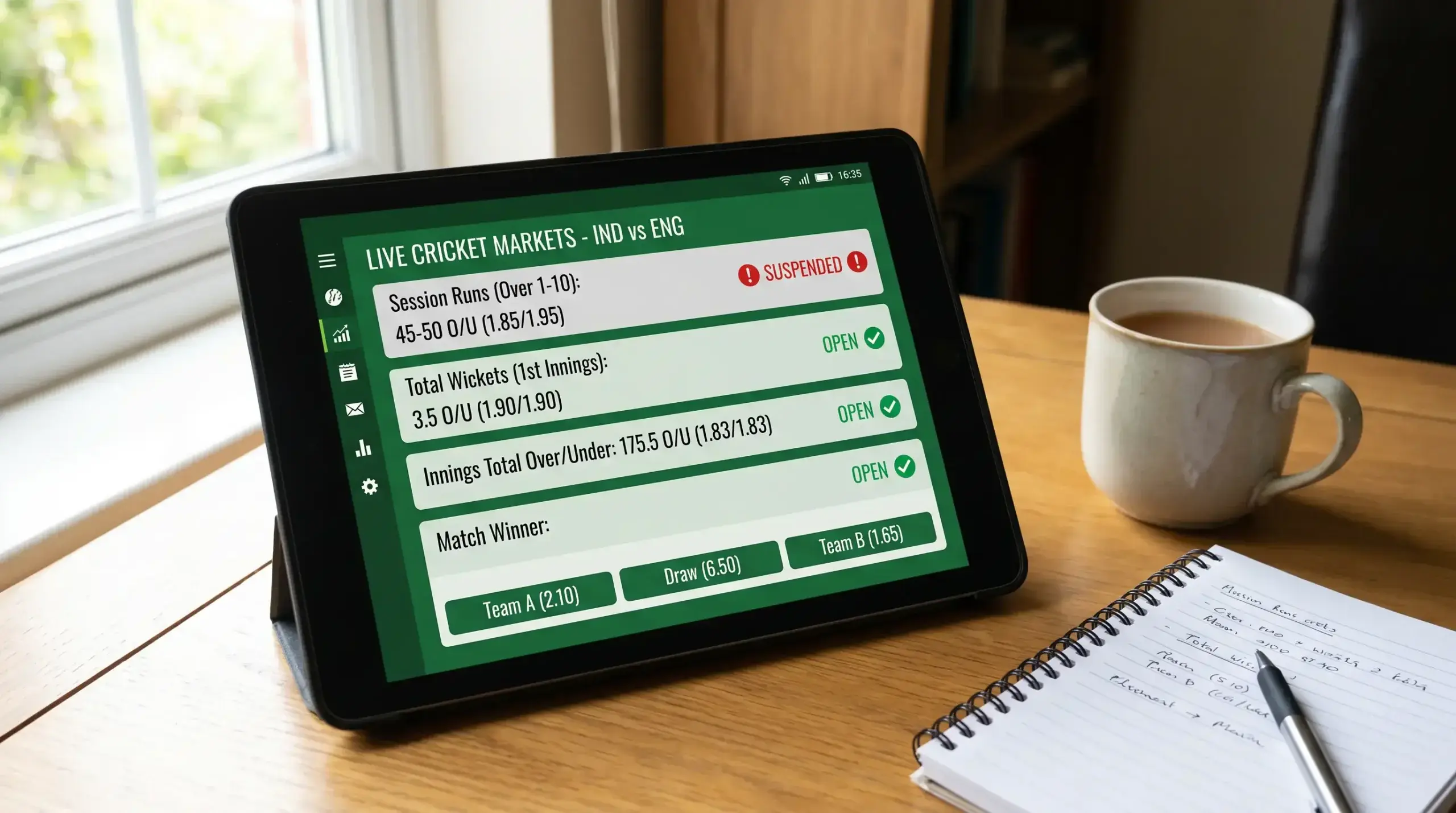
One mechanical detail worth noting: most bookmakers display a small indicator showing whether a market is “open” or “suspended” in real time. Get used to watching this indicator before attempting to place a bet. Clicking into a suspended market and waiting for it to reopen means you’re committing to bet at whatever price emerges — which may be significantly different from the price you had in mind. The best practice is to identify the price you want, wait for the market to open, and act decisively within the two-to-three-second window before the next ball is bowled.
In-Play Markets: What You Can Bet On Mid-Match
The range of in-play markets has expanded dramatically in the last three years. When I started betting on cricket, live options were basically limited to match winner and innings runs. Now, a high-profile T20 match might offer thirty or more in-play markets simultaneously.
Match winner remains the most liquid and widely traded in-play market. The odds adjust after every significant event — wickets, milestones, dropped catches, rain interruptions — and the swings can be substantial. In a close T20 chase, match winner odds can flip from one side to the other multiple times in the final five overs.
Over runs — how many runs will be scored in a specific over — is a pure in-play product. Bookmakers set a line (typically around 6.5 to 8.5 depending on the phase of play and format) and you bet over or under. This market resets every six balls, making it fast-cycling and high-volume. I treat it with caution because the margins are wider than on match-level markets, but it’s useful when you have a strong read on a specific bowling matchup.
Next batsman to score runs, method of next dismissal, and batsman to hit next boundary are all ball-by-ball or event-by-event markets. They’re the closest thing to “instant” betting and they carry the highest bookmaker margins. The appeal is obvious — every delivery could settle the bet — but the edge available to bettors in these micro-markets is minimal. The bookmaker’s algorithm is pricing off the same data you’re watching, and its reaction speed is faster than yours.
Innings total markets are more strategic. Betting on whether the first innings will exceed, say, 165.5 runs in a T20 requires a view on the pitch, the batting lineup, the bowling attack, and the conditions. These markets stay open throughout the innings and the odds adjust as the innings progresses, creating opportunities at different phases — after the powerplay, during the middle overs, and in the death.
Session markets in Test cricket — runs scored and wickets taken in a morning, afternoon, or evening session — are among the most analytically rewarding in-play markets. They require understanding of how a pitch plays at different times of day, how the ball behaves under lights, and how teams approach different match situations. The session is long enough that a single event doesn’t dominate the outcome, but short enough that your analysis of conditions can genuinely outperform the market’s starting price.
In-Play Dynamics by Cricket Format
Not all in-play cricket is created equal. The pace of odds movement, the types of markets available, and the strategic opportunities differ fundamentally between formats. Treating a Test match in-play session the same way you’d approach a T20 final is a recipe for poor decisions.
T20 and The Hundred: Powerplay Swings
T20 and The Hundred produce the most volatile in-play markets in cricket. With only 120 balls per innings — or 100 in The Hundred — every delivery carries disproportionate weight. A six off the first ball of an over can shift the required rate enough to move match winner odds by a full tick. A wicket in the powerplay, especially of a set opener, can swing them further still.
The IPL 2025 Final attracted around 300 million viewers across TV and digital platforms, and the entire season exceeded one billion viewers — numbers that translate directly into betting volume and market depth. High-profile T20 fixtures generate the most liquid in-play markets, which means tighter spreads and more accurate pricing. That sounds like bad news for bettors, but liquidity also means you can get meaningful stakes matched at the price you want, which isn’t always the case in lower-profile matches.
Powerplay overs (1-6) are the highest-variance phase of any T20 innings. Batting sides take risks against the new ball with fielding restrictions in place, producing clusters of boundaries interspersed with wickets. In-play odds during the powerplay can move 15-20% in the space of two overs. If you’re going to bet in-play on T20s, the transition from powerplay to middle overs — when the field spreads and the run rate typically dips — is often where the best entry points emerge, because the algorithm’s odds adjustment slightly overshoot the immediate trend.
Test Matches: Session-by-Session Shifts
Test cricket operates on a completely different time scale. Five days, four innings, and a draw as a possible outcome. In-play betting on Tests rewards patience above everything else. The odds move slowly during periods of attritional batting but can shift sharply at session breaks, when conditions change (the new ball, a pitch cracking, or the lights coming on), or when a key wicket falls after a long partnership.
The draw market is unique to Tests and it’s one of the most interesting in-play propositions in all of cricket. Early in a match, the draw might be priced at 4.00 or higher. If the first two days produce flat batting pitches and big first-innings totals, the draw price shortens. If rain washes out a full day, it shortens dramatically. I’ve had some of my best results backing the draw in-play when weather forecasts suggest further interruptions that the market hasn’t fully priced in.
Session-by-session analysis is the key to profitable Test match in-play betting. Morning sessions in England often favour seamers with a new or relatively new ball. Afternoon sessions on subcontinental pitches can turn into spin-dominated affairs. The evening session under lights brings the pink ball into play with its extra movement. Each of these dynamics creates a micro-environment within the larger match, and the in-play odds don’t always reflect these patterns as accurately as they might.
Timing Your Bets: Entry and Exit Points
I once placed a bet on the chasing side in an ODI at the end of the powerplay, right after they’d lost their third wicket. The match winner odds had ballooned to 4.50, and from my read of the conditions — a flat pitch, a deep batting lineup, and a target below par — the overreaction was obvious. They won comfortably, and the bet returned well. But the timing was everything. Five overs earlier, the same bet at 2.00 would have offered half the value. Five overs later, the price had already corrected back to 2.80.
Timing in-play cricket bets is about identifying moments where the odds have overreacted to a recent event. The algorithm reprices after every ball, and its short-term adjustments tend to over-weight the most recent data point. A cluster of wickets pushes match winner odds too far in one direction. A boundary-heavy over nudges run totals too aggressively. These corrections usually happen within a few overs, so the window for exploiting them is narrow.
My general framework for in-play entry points: bet against the trend, not with it. When everyone else is reacting to what just happened, look at what’s likely to happen next. If a top-order collapse has moved the odds dramatically but the middle order has genuine quality and the pitch is still good, the post-collapse price overestimates the bowling side’s advantage. If a batting powerplay has been explosive but the middle-overs bowlers are strong, the batting side’s price after the powerplay underestimates the slowdown coming.
Exit points are equally important, and this is where cash out becomes a strategic tool rather than a panic button. If you’ve backed a side at long odds and the match has moved in your favour, there’s a point where the potential gain from holding the bet is outweighed by the risk of reversal. In T20 cricket, that point comes fast — sometimes within a few overs. In Tests, you might hold a position for an entire session before deciding whether to cash out or let it run. The discipline is in knowing your threshold before the match starts, not making it up in the heat of the moment.

Using Live Streams and Match Data for In-Play Decisions
There’s a meaningful difference between betting in-play while watching the match and betting in-play while staring at a scorecard. The online segment now accounts for about 75% of the sports betting market, and a significant portion of that in-play activity happens on mobile devices where live streaming is built into the betting app. If you’re serious about in-play cricket betting, access to a live stream or, at minimum, a ball-by-ball commentary feed is not optional.
Live streams through bookmaker platforms typically run with a delay of three to eight seconds behind the actual action. That delay matters. It means the odds you see have already been adjusted for something that hasn’t appeared on your screen yet. If you’re relying on the stream to inform your bets, you’re always slightly behind the market. The advantage of streaming isn’t in reaction speed — it’s in context. Watching the match lets you assess things the algorithm can’t easily quantify: a batsman’s body language, the wear on the pitch, the angle of the seam, whether the fielding team’s energy levels are dropping.
Ball-by-ball data feeds and live scoring apps provide complementary information. Wagon wheels show where a batsman is scoring, pitch maps reveal bowling patterns, and run-rate graphs illustrate momentum shifts over time. I use these tools alongside the stream, not instead of it. The stream gives qualitative context; the data gives quantitative precision. Together, they produce a better picture than either alone.
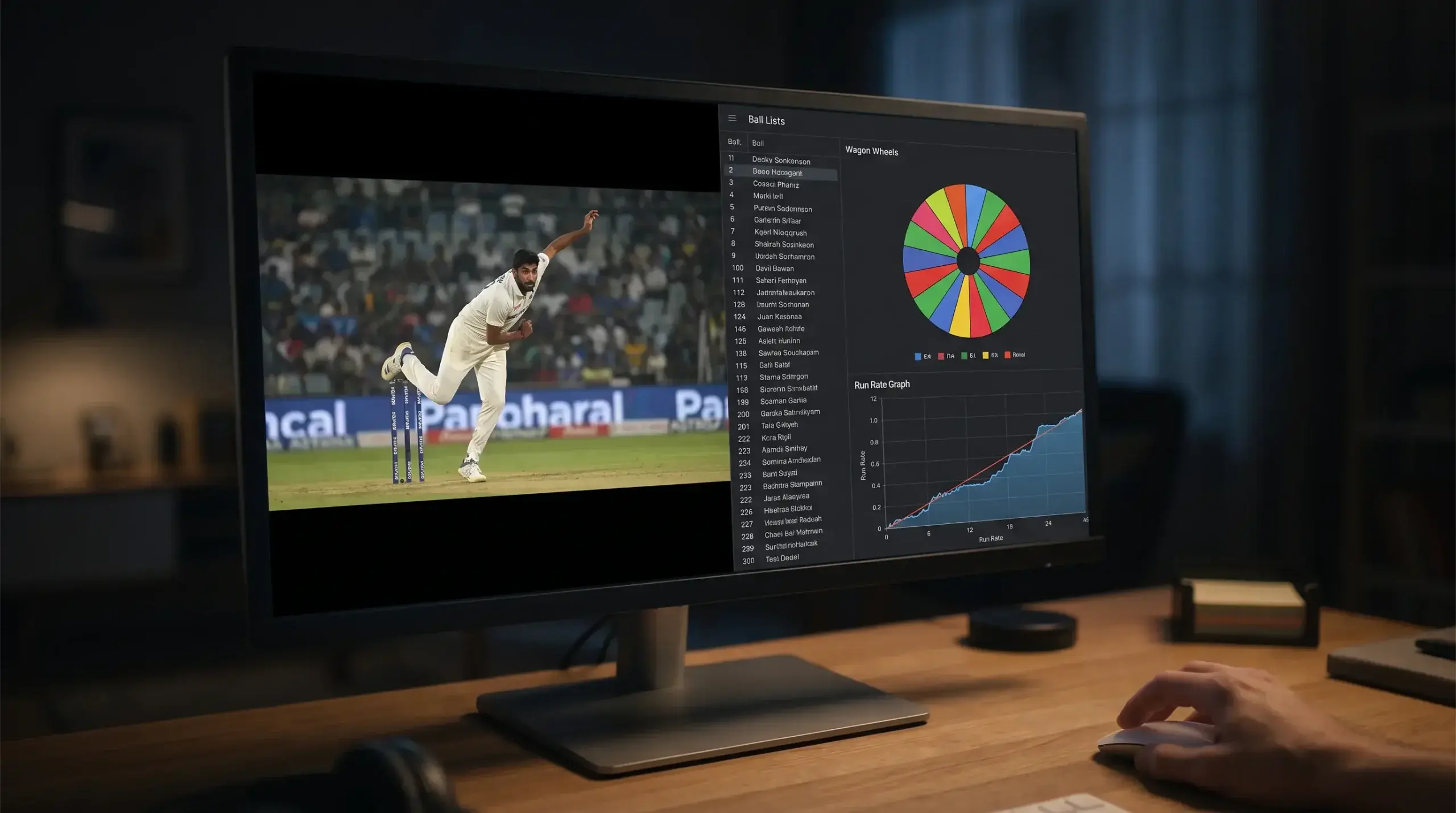
One data source most bettors overlook: the partnership. How many runs the current pair have put on, at what rate, and how long they’ve been at the crease. In-play odds adjust for wickets dramatically but adjust for partnerships more gradually. A 50-run stand between two set batsmen changes the match dynamics more than most algorithms fully capture in real time, particularly in Test cricket.
Managing Risk in Fast-Moving In-Play Markets
The speed of in-play cricket betting is what makes it exciting — and what makes it dangerous. I’ve seen people blow a week’s betting bankroll in twenty minutes during a T20 because each ball felt like a fresh opportunity and each loss felt like it needed an immediate correction. The pace of the game creates a psychological pull toward constant action that works against disciplined betting.
The regulatory framework around in-play betting is evolving fast, and for good reason. The Gambling Commission has invested heavily in areas like illegal gambling investigations and data capabilities, though funding for these initiatives faces constraints beyond the next financial year. In-play products — with their speed, their volume, and their appeal to impulsive decision-making — sit at the centre of that regulatory attention.
My risk management framework for in-play cricket betting comes down to three rules I don’t break. First, I set a maximum number of in-play bets per match before it starts. For a T20, that’s usually two. For a Test, it might be three or four across the full five days. This prevents the “just one more bet” spiral that turns a considered approach into compulsive gambling.
Second, I use the same staking plan for in-play bets as pre-match. The temptation to increase stakes when you feel you’ve spotted a live opportunity is strong, but it’s also the fastest way to overexpose yourself. A flat stake — the same unit amount on every bet regardless of confidence level — removes the emotional escalation that in-play markets encourage.
Third, I take breaks. If I’ve had two losing in-play bets in a session, I stop betting for the rest of that match. Not because three losses in a row means I’m doing something wrong — variance is normal — but because the emotional state after consecutive losses impairs judgment. The market will still be there tomorrow. My bankroll needs to be there too.

In-Play Is Where Cricket Betting Comes Alive
Everything that makes cricket a compelling sport to watch — the shifting dynamics, the tactical battles, the moments of individual brilliance that overturn established positions — is amplified when you have a considered stake in the outcome. In-play betting lets you participate in the match’s narrative in a way that pre-match betting can’t replicate. But that intensity cuts both ways. The bettors who thrive in live markets are the ones who prepare before the first ball, set boundaries they don’t cross, and treat the stream as an information source rather than an adrenaline feed. The match will tell you when to act. Your job is to be ready when it does.
