


Why Generic Tips Fail and Data-Led Strategies Work
Two years into my cricket betting career, I subscribed to three different tipster services. One charged fifteen pounds a month, another twenty, the third offered a “premium” tier at fifty. After six months of meticulously tracking every recommendation, the combined record was almost exactly what you’d expect from random selection adjusted for the bookmaker’s margin — a slow, steady loss. Not because the tipsters were fraudulent (though some certainly are), but because generic cricket tips without context are fundamentally useless. “Back India in subcontinental T20s” isn’t a strategy. It’s a slogan.
The UK cricket betting market generates around 52 million pounds annually — a small slice of the 2.37-billion-pound online sports betting sector, but one that attracts a specific kind of bettor. Only about 7% of British sports bettors wager on cricket, which means the market is less saturated than football and, in my experience, more rewarding for those who bring genuine analytical depth.
What I’m sharing here isn’t a collection of tips. It’s a framework — a systematic approach to cricket match analysis that produces better decisions over hundreds of bets. No single piece of advice will make you profitable. But a consistent method of researching, evaluating, and staking, applied with discipline across a full season, can. That distinction between tips and systems is the first thing to internalise.
Building a Pre-Match Research Framework
Before the 2025 Ashes, I spent an afternoon building a pre-match checklist for each Test venue. Pitch history over the last five years, average first-innings scores, win-loss ratios for teams batting first versus second, average session run rates, and typical wicket-taking phases. It took about three hours to compile. Over the course of the series, that checklist saved me from at least two bets I would have placed on instinct and steered me toward three I wouldn’t have considered. The time investment paid for itself many times over.
A pre-match research framework isn’t complicated, but it needs to be consistent. Every match, the same questions, in the same order, before you even look at the odds. My framework has five layers.
First, venue and pitch. What has this ground produced historically? Is it a batting paradise, a seamer’s paradise, or does it deteriorate and turn as the match progresses? What’s the groundsman said? What do the local journalists report about pitch preparation? For international matches, this information is widely available. For domestic matches, it requires more digging — county cricket forums, local press, social media from players who’ve trained on the surface.
Second, team composition. Who’s in the squad, and who’s likely to play? Late team news is one of the most reliable sources of odds movement, and getting ahead of it — even by a few minutes — can provide value. Follow team social media accounts, press conference summaries, and injury bulletins. In franchise cricket, player availability changes constantly due to international commitments, so a team that was strong last week might be missing three key players this week.
Third, recent form. Not career averages — recent form. How have the key batsmen performed in the last five innings? How have the bowlers performed on similar pitches? Form in cricket fluctuates more than in most sports because conditions vary so dramatically between venues and formats. A batsman averaging 55 across his career might be averaging 12 in his last four innings on seaming English pitches.
Fourth, head-to-head records. Some teams consistently outperform others regardless of relative strength. Some bowlers have specific batsmen’s number. These matchup patterns, especially in franchise cricket where the same teams face each other multiple times per season, create persistent edges that the market doesn’t always fully price.
Fifth, the odds themselves. Only after I’ve formed a view based on the first four layers do I look at what the bookmaker is offering. This order matters. If you look at the odds first, you anchor to the market’s assessment and your “independent” analysis becomes contaminated by the price you’ve already seen. I write my probability estimate down before opening the sportsbook. If my number and the market’s number diverge meaningfully, there might be a bet. If they’re broadly aligned, I pass and wait for the next match.

Format-Specific Strategies: Test, T20, ODI
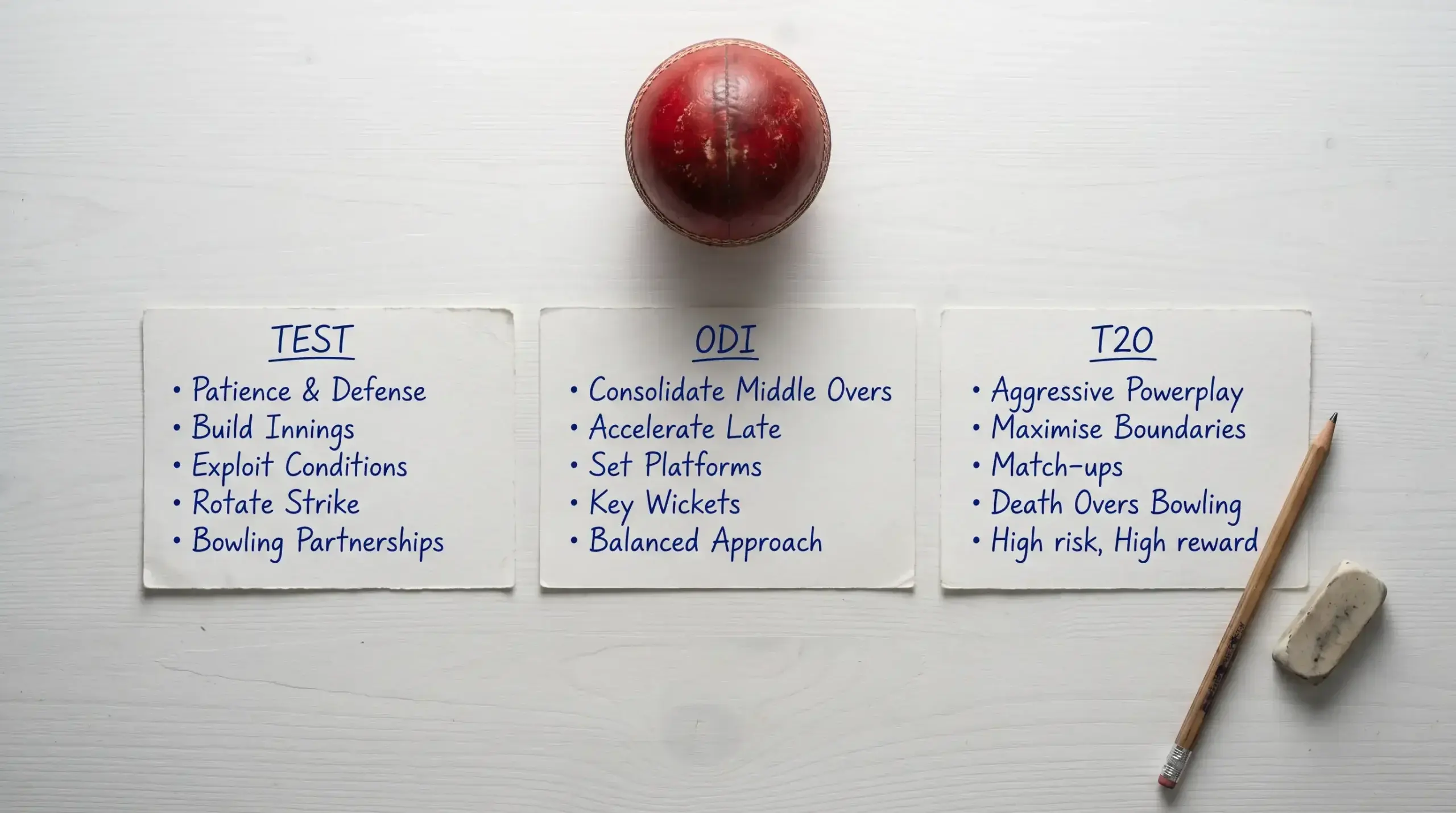
I treat Test, T20, and ODI betting as three almost entirely different disciplines. The variables that matter, the markets that offer value, and the timing of optimal bet placement differ so fundamentally between formats that applying one approach to all three is a guaranteed way to underperform.
In Test cricket, the draw is the market that changes everything. Three possible outcomes instead of two means the bookmaker’s overround is distributed differently, and the draw price creates tactical betting opportunities that don’t exist in limited-overs cricket. My most consistent Test betting strategy involves backing the draw when conditions or match situations suggest a result is less likely than the market implies — rain-affected matches on flat pitches, fifth-day declarations that run out of time, and first-innings scores that suggest the pitch isn’t deteriorating as expected.
T20 demands a completely different mindset. The majority of UK cricket bets are placed during the match rather than before it, and T20 generates the highest in-play volume of any format. The pre-match bet is only half the picture. My T20 strategy concentrates on two phases: pre-match positioning based on conditions and team composition, and selective in-play entries during the transition between powerplay and middle overs, where the algorithm tends to over-correct after early batting fireworks or early wickets.
ODI cricket sits in the middle and is, in some ways, the hardest format to bet on. Fifty overs is long enough for the match to turn multiple times but short enough that a single session of aggressive batting can decide it. I focus on innings total markets in ODIs more than match winner, because the 50-over structure produces more predictable scoring patterns in aggregate even when individual match results are volatile. The first ten overs and last ten overs of each innings are the phases I analyse most closely, because that’s where scoring rates deviate most from the middle-overs norm.
Reading Conditions: Pitch, Weather and Venue
No other sport is as sensitive to playing conditions as cricket. A pitch that’s been baked under sun for three days behaves completely differently from one that’s been under covers during rain. Overcast skies make the ball swing more. Wind direction affects both bowlers’ lines and batsmen’s shot selection. Dew in evening sessions can make the ball skid and render spin bowling ineffective. If you’re betting on cricket without checking how weather and pitch conditions affect the odds, you’re ignoring the single most influential variable in the sport.
Pitch reports are your primary tool. Most international and franchise grounds now publish pitch condition updates in the days before a match, and broadcasters routinely show close-up footage of the surface during the build-up. What you’re looking for: grass coverage (more grass favours seam bowlers), cracks (favour spin as the match progresses), moisture (helps swing and seam early), and colour (a dry, dusty pitch tends to be slower and lower).
Venue history provides context that a single pitch report can’t. Some grounds consistently produce high-scoring matches; others are perennially bowler-friendly. Headingley, for instance, has historically offered more assistance to seam bowling than The Oval. The SCG in Sydney turns for spinners more than the MCG in Melbourne. These patterns hold over time even as individual pitch preparations vary, and they should inform your baseline expectation for any match at a given venue.
Weather forecasts need to be checked at the hourly level, not the daily level. A morning shower that delays the start by an hour can change how the pitch plays for the rest of the day. Overcast conditions forecast for the afternoon session of a Test may encourage a captain to bowl first, shifting the pre-match dynamics. I use multiple weather sources and cross-reference them, because a single forecast can be significantly off, especially for UK venues where conditions change rapidly.

How the Toss Affects Match Odds
I tracked the toss impact on match winner odds across 120 T20 internationals over two seasons. The average odds shift after the toss was 8-12%, and in subcontinental day-night matches with a significant dew factor, shifts of 15-20% were common. A coin flip shouldn’t matter this much in theory, but in practice, it’s one of the most consequential moments in any cricket match.
The toss matters because batting conditions in cricket change over time. In Test matches, the pitch deteriorates, making batting harder on later days. In day-night matches, the ball swings more under lights. In subcontinental T20s, dew in the second innings makes the ball harder to grip, neutralising spin bowlers and making batting easier for the chasing side. The captain who wins the toss gets to choose the more favourable conditions, and that advantage is reflected immediately in the odds.
My approach to the toss is simple: I form my pre-match view before the toss, note my target price, and then reassess once the toss is done. If the toss result confirms my pre-match lean and the odds now offer less value, I might reduce my stake or pass entirely. If the toss goes against my expected side but the market has overreacted, that’s often where the best value appears. The key is not to let the toss override your analysis — it should adjust your confidence, not replace your thinking.
In formats and venues where the toss impact is historically neutral — some English grounds in summer where conditions don’t change much across a day, or ODI matches on flat pitches with no dew — I’m comfortable placing pre-match bets before the toss. But for any match where conditions are likely to diverge significantly between first and second innings, waiting for the toss is a discipline that consistently improves my entry prices.

Tracking Player Form and Team Selection
The IPL 2025 season attracted over one billion viewers worldwide, and that massive audience produced an enormous amount of publicly available performance data. Every ball bowled, every run scored, every dismissal catalogued and analysed. For bettors, this data is raw material — but only if you know what to look for and, more importantly, what to ignore.
Career averages are a starting point, not an answer. A batsman with a career T20 strike rate of 140 might be striking at 110 in the current tournament because he’s been moved up the order, because the pitches have been slower than usual, or because he’s carrying a minor injury that limits his shot range. Recent form — the last five to ten innings — is a better predictor of near-term performance than career numbers, especially in franchise cricket where conditions and roles change frequently.
Team selection is equally critical and often overlooked. Franchise tournaments have rolling squads, with players arriving and departing as international commitments shift. An IPL side might lose its frontline spinner to national duty and replace him with a promising but unproven local player. That change might not shift the overall match winner odds dramatically, but it could significantly affect player-specific markets like top bowler or total wickets.
I maintain a tracking spreadsheet for the leagues I bet on regularly. It’s not sophisticated — just a running log of key players’ recent performances, injury status, and availability. Before any match, I check which players are confirmed available, how they’ve performed in their last few outings, and whether any matchup factors (left-arm spinner against right-hand-dominant batting lineup, for example) are worth weighting. This takes about fifteen minutes per match. Compared to the hours some people spend reading tipster predictions, it’s a far better use of time — and it’s your own analysis, which means you understand the reasoning behind every bet you place.
Staking Plans and Emotional Discipline
The 25-34 age group is the most active in UK sports betting — 87% place at least one bet per month. That frequency creates ample opportunity to build a track record — but also ample opportunity to blow through a bankroll if staking isn’t controlled.
I use flat staking: the same amount on every bet, regardless of how confident I feel. It sounds boring, and it is. It’s also the single most effective thing I’ve done for my long-term results. When I used to vary my stake based on confidence — “I’m really sure about this one, let me put double on it” — my record showed that my high-confidence bets performed no better than my standard bets. What they did do was amplify losses on the occasions I was wrong. Flat staking removed that trap.
The alternative most often discussed is percentage staking, where you bet a fixed percentage of your current bankroll on each wager. This has the mathematical advantage of adjusting your exposure as your bankroll grows or shrinks — you bet more when you’re winning and less when you’re losing, which protects against ruin. The Kelly Criterion takes this further, calculating the optimal stake based on your estimated edge. In theory, Kelly maximises long-term bankroll growth. In practice, it requires accurate probability estimates, which is the one thing no bettor can guarantee.
Whatever staking plan you choose, the non-negotiable element is emotional discipline. Cricket’s calendar is dense enough that losing streaks feel interminable and winning streaks feel like vindication of genius. Neither is true. Variance in cricket betting is high — even a profitable bettor can easily have a losing month — and the temptation to adjust stakes based on recent results rather than process is the fastest way to undermine an otherwise sound strategy.
I keep a simple rule: if I feel the urge to increase my stake on a particular bet, that’s a signal to step back, not to bet more. The urge is emotional, not analytical, and the last eight years have taught me that emotional staking decisions have a negative expected value regardless of how good the underlying selection might be.

Cognitive Biases That Cost Cricket Bettors
A few years ago, I backed England in every home Test for an entire summer because “England don’t lose at home.” They lost twice. My analysis hadn’t been wrong about the individual matches — in both cases, the data pointed toward risk factors I’d chosen to overlook because they conflicted with my narrative. That’s confirmation bias in action, and it’s the most expensive cognitive error in cricket betting.
Confirmation bias makes you seek out information that supports the bet you’ve already decided to place and dismiss information that contradicts it. The fix is structural: complete your analysis before forming a view. Assess the pitch, the teams, the conditions, the form data, and only then decide which side you favour. If the data is ambiguous, the correct decision is often to skip the match entirely rather than force a position.
Recency bias is equally damaging. A team that’s won their last four T20s feels like a safe bet, even if those wins came on different pitches against weaker opposition and the current match presents entirely different conditions. I’ve trained myself to weight recent results lower than conditions-specific analysis, because a team’s form on slow subcontinental pitches tells you very little about how they’ll perform on a bouncy Johannesburg wicket.
The gambling landscape itself is changing under bettors’ feet. Remote Gaming Duty nearly doubled to 40% in April 2026, and the ripple effects are still playing out — operators adjusting margins, markets thinning in lower-profile sports, promotional offers shifting in structure. Neal Menashe, CEO of Super Group, captured the industry’s concern when he called on the government to pair the tax increase with strict enforcement against offshore operators who don’t pay tax and don’t invest in responsible gambling. If regulated operators lose market share to unregulated alternatives, the odds landscape changes for everyone. Anchoring to historical patterns without questioning whether the competitive environment has shifted is a cognitive trap that costs money.
Sunk cost bias — the reluctance to abandon a losing position because you’ve already “invested” in it — shows up in cricket betting through the refusal to cash out at a loss. If you’ve backed a team and they’re three wickets down in the powerplay, the rational question is: “Would I place this bet now, at the current odds, with the current match state?” If the answer is no, the original stake is irrelevant. Cash out, take the loss, and move on. The money you’ve already staked is gone regardless of what you do next.

Strategy Is a Process, Not a Prediction
Every bettor wants the prediction that lands at 10/1. What separates those who sustain results from those who don’t is the process underneath the prediction. Research the match. Assess the conditions. Build an independent probability estimate. Compare it to the market. Stake consistently. Record everything. Review honestly. That cycle, repeated across hundreds of bets, is the only strategy that works. Everything else is noise dressed up as insight.
